
Showing posts with label steam programs. Show all posts
Showing posts with label steam programs. Show all posts
Thursday, November 5, 2015
Science Playground at the @alscblog
Today, I'm over at the ALSC Blog with a post about our recent Science Playground. Please click through and check out this easy, cheap, well-attended fall break program!


Monday, November 24, 2014
Preschool Lab: Kitchen Science
With a big American food holiday coming up this week, I thought kitchen science would be a fun topic for this month's preschool lab. I have some thoughts about this program, but first I'll tell you what we did:


Storytime:
Opening Song: My Hands Say Hello
Book: The Cazuela That the Farm Maiden Stirred by Samantha Vamos, illustrated by Rafael Lopez (Charlesbridge, 2011). In this cumulative tale, a farm maiden and her barnyard friends are making arroz con leche - rice pudding - and each animal has something to add to the pot (cazuela!). If you're not familiar with the Spanish words included in this brightly-illustrated story (I was not!), there's a pronunciation guide in the back of the book and I'd recommend reading it out loud a couple of times before you read it to your group. My audience was not Spanish-speaking, so I would occasionally repeat a Spanish word in English. Cumulative books are great for helping children learn new vocabulary.
Felt Rhyme: Five Red Apples
Book: Soup Day by Melissa Iwai (Henry Holt, 2010). On a cold snowy day, a little girl and her mother make vegetable soup. This story takes them through all the steps, from buying ingredients at the market to chopping and cooking the vegetables to waiting for it to cook to serving it for dinner. This is another great book for introducing children to new vocabulary and I like that it clearly shows the steps you follow in cooking.
Felt Activity: Healthy Foods. I put up the MyPlate and talked very briefly about the different kind of foods that we eat. I passed out the different felt pieces and went around the plate, calling up the vegetables, then the fruit, then the grains, then the protein, and the dairy. This is a good activity for learning new vocabulary words. Children also practice listening, following instructions, and approaching an adult who's not in their family.
Book: Bear Snores On by Karma Wilson, illustrated by Jane Chapman (Margaret K. McElderry Books, 2002). This fun rhyming story is perfect for this time of year. While Bear hibernates in his den, his animal friends take shelter from the storm, one by one contributing snacks and food for a wintry party. Sharing books with rhyming words helps children hear that words are made up of smaller sounds.
Stations:
Pasta Shapes: I put out small piles of pasta in different shapes and prompted kids to sort them and count them. Sorting and counting are both math skills and playing with shapes helps with the ability to recognize letters.
Bean Measuring. I purchased two large bags of pinto beans and put them out with all kinds of measuring cups. Measuring is a math activity that young kids can help with in the kitchen.
Play Food and Felt Board. I also put out a set of play food and dishes and I let the kids explore the food set on the felt board. Imaginative play helps develop vocabulary (you'd be amazed at what words you find yourself using as you go through imaginative play with a child!) and self-regulation skills like taking turns and sharing.
My thoughts:
So, I had the best of intentions with this one and the kids did have fun. They mostly stayed at the beans station and the play food station.
However, when I thought this one up I had wanted to include a lot more science-based stations and, due to a super-heavy programming schedule this month, that just didn't happen. My thinking was to give parents some ideas for fun things to keep their kiddos occupied while they potentially spent a lot of time in the kitchen this week. SO, if you want to include more explicitly STEM-based stations (using stuff you'll find in the kitchen!), here are ideas for you:
- Baking soda & vinegar
- Explore density at Science Sparks
- Explore wet and dry at Science Sparks
- Make an easy recipe together (fruit salad?) to practice step-by-step instructions
- Make butter at Science Sparks
- Weigh different vegetables
You can search "preschool kitchen science" on Pinterest for TONS of additional activity ideas.
Monday, October 27, 2014
Preschool Lab: Bats
I don't know if you know this about me, but I love bats! I think they're awesome! And with Halloween coming up this week, what better time to explore bats in our Preschool Lab? Here's what we did.
Storytime:

Opening Song: My Hands Say Hello
Book: Bats in the Library by Brian Lies (Houghton Mifflin Harcourt, 2008). I shortened this one a bit since I tend to have a young, wiggly crowd. We talked about bats being nocturnal and pointed out funny things the bats were doing in the pictures. The text is rhythmic and rhyming. Hearing rhyming words promotes phonological awareness, the ability to hear that words are made of smaller sounds. Even though this is definitely a made-up story, there are lots of fun details that present facts in the picture (like when the bats are looking at "fancy food guides", they're actually looking at insect books!).
.JPG)
Felt Activity: Color Bats. I had made this set for a nocturnal animals storytime some time ago. We again talked about bats being nocturnal. I passed out the bats and then read this rhyme to call kids up to put their bats on the board:
The sun is setting,
The moon's rising high.
Now all the red bats
Start to fly!
After all the bats had been placed on the felt board, I told them that a group of bats is called a colony and together we counted the number of bats in our colony.
If you want to continue the fun, talk about how bats sleep (hanging upside down) and you can turn your bats upside down as you say this rhyme:
The moon has gone,
The sky's getting light
And all the red bats
Say goodnight!
Not only does this activity reinforce the idea of bats being nocturnal (though the repeated rhyme), it helps kids practice colors and get more comfortable with approaching an adult who is not in their family (school readiness skills!).
Book: Zipping, Zapping, Zooming Bats by Anne Earl, illustrated by Henry Cole (HarperCollins, 1995). The full text of this book is too much for my littles, but I did use one spread that shows the bat's wing. We talked about how a bat's wing is different from a bird wing - no feathers and the bone structure is different. And we talked about how a bat's finger bones make up the structure for its wings, so a bat is able to make its wings bend in many different ways. And we demonstrated using our own fingers.
I think the concept would have hit home more if I had a bat model, even a stuffed or large plastic bat to really show them where the bones are. But some of the kids got it, I think!
Book: Hello, Bumblebee Bat by Darrin Lunde, illustrated by Patricia Wynne (Charlesbridge, 2007). This simple nonfiction picture book is great for sharing with a young group. Simple text asks and answers many questions about the smallest of bats. It's quite easy to skip spreads if you need to shorten. And I had one little gentleman who somehow asked a bunch of questions out of curiosity just as we got to the spreads that answered those questions!
Closing Song: Do You Know What Time It Is?
Stations:


Storytime:
Opening Song: My Hands Say Hello
Book: Bats in the Library by Brian Lies (Houghton Mifflin Harcourt, 2008). I shortened this one a bit since I tend to have a young, wiggly crowd. We talked about bats being nocturnal and pointed out funny things the bats were doing in the pictures. The text is rhythmic and rhyming. Hearing rhyming words promotes phonological awareness, the ability to hear that words are made of smaller sounds. Even though this is definitely a made-up story, there are lots of fun details that present facts in the picture (like when the bats are looking at "fancy food guides", they're actually looking at insect books!).
Felt Activity: Color Bats. I had made this set for a nocturnal animals storytime some time ago. We again talked about bats being nocturnal. I passed out the bats and then read this rhyme to call kids up to put their bats on the board:
The sun is setting,
The moon's rising high.
Now all the red bats
Start to fly!
After all the bats had been placed on the felt board, I told them that a group of bats is called a colony and together we counted the number of bats in our colony.
If you want to continue the fun, talk about how bats sleep (hanging upside down) and you can turn your bats upside down as you say this rhyme:
The moon has gone,
The sky's getting light
And all the red bats
Say goodnight!
Not only does this activity reinforce the idea of bats being nocturnal (though the repeated rhyme), it helps kids practice colors and get more comfortable with approaching an adult who is not in their family (school readiness skills!).
Book: Zipping, Zapping, Zooming Bats by Anne Earl, illustrated by Henry Cole (HarperCollins, 1995). The full text of this book is too much for my littles, but I did use one spread that shows the bat's wing. We talked about how a bat's wing is different from a bird wing - no feathers and the bone structure is different. And we talked about how a bat's finger bones make up the structure for its wings, so a bat is able to make its wings bend in many different ways. And we demonstrated using our own fingers.
I think the concept would have hit home more if I had a bat model, even a stuffed or large plastic bat to really show them where the bones are. But some of the kids got it, I think!
Book: Hello, Bumblebee Bat by Darrin Lunde, illustrated by Patricia Wynne (Charlesbridge, 2007). This simple nonfiction picture book is great for sharing with a young group. Simple text asks and answers many questions about the smallest of bats. It's quite easy to skip spreads if you need to shorten. And I had one little gentleman who somehow asked a bunch of questions out of curiosity just as we got to the spreads that answered those questions!
Closing Song: Do You Know What Time It Is?
Stations:
Hear Like a Bat - This simple activity is designed for kids and caretakers to do together and it illustrates how bats "see" with sound (very simplified, of course). One person puts the blindfold on and the other person rattles a maraca. The blindfolded person points to where the sound is coming from. This activity was adapted from Child Care Lounge.
Measure a Bat - Did you know that there are over 1200 species of bats and they come in many different sizes? Miss T created these paper bats for me, illustrating the great size difference in different types of bats. Pictured here, you see the flying fox with a wingspan of 5 feet, the Indiana bat with a wingspan of 10 inches, and the bumblebee bat with a wingspan of 6 inches. I put out rulers and invited kids to measure the bats.
Nocturnal Animal Puppets - The most fun station for everyone was our nocturnal animal puppets. I looked up a list of nocturnal animals online and found that we actually had quite a few nocturnal animals in our puppet collection! I put out a fox, deer, wolf, beaver, owl, cat, mouse, possum, and firefly for the kids to play with.
All in all, the stations were not super popular this time around, but the storytime went over better than I thought it would. The kids were really interested in the books, asking great questions and sharing what they knew. We also learned some great vocabulary words like "nocturnal" and "echolocation".
And, of course, I am happy to spread my love of bats to the next generation!
Tuesday, September 9, 2014
Preschool Lab: Shapes
This was our first week back for Preschool Explorers and I started us off with a really easy and fun theme: shapes! Shapes probably doesn't necessarily fit within science themes, BUT it definitely fits into math (the M in STEM!), and learning shapes is great for letter recognition later. Also, I got a great set of foam shapes and I wanted to put them to use!


Storytime:
Opening Song: My Hands Say Hello - This is our standard opener; it signals to the kids that we're ready to start storytime.
Book: Round is a Mooncake by Roseanne Thong. This picture book examines three different shapes: circle, square, and rectangle. In each spread, rhyming text talks about where we might find these shapes in the world around us. The illustrations feature a Chinese girl and her family and friends, so we see many Chinese items in the illustrations. Circles are found in mooncakes and lanterns, squares are found in a name chop (name stamp) and tofu cakes, etc.
Felt: Shape name cards. We have a set with the names of shapes ("circle", "diamond", "oval", etc.), felt shapes, and then objects of different shapes. I put all the words up on the board and then as I brought each felt shape out, asked the children to name the shape and then put it with the appropriate word. This activity helps reinforce shape vocabulary (and possibly introduce new vocabulary like "oval") and it shows children that printed words have meaning.
Song: The Shape Shake by CJ (you can find it on his album "Move It!") I was introduced to this song by one of my staff members who used to be a Kindergarten teacher. We do lots of shaking and then use our hands to draw shapes in the air. It's a great movement song and it introduces kids to concepts like "horizontal line" and "vertical line", as well as practicing shapes.
Book: Lots of Dots by Craig Frazier. Simple, rhyming text points out circles ("dots") that are everywhere we look! I chose this book because it tied in nicely with our shape hunt station (more info below!).
Book: Color Zoo by Lois Ehlert. This book introduces kids to many different shapes! Cutaway illustrations reveal different animals made up of shapes. Text simply labels each animal and as I turned the pages, I asked the kids what shapes they saw. This book also introduces octagon (8 sides) and hexagon (6 sides), and when we got to those shapes I counted the sides with the kids. Great new vocabulary!
Felt: Color shapes. We have a set of different objects in different shapes (i.e. a circle clock, a rectangle door, and oval Easter egg) and I passed out a shape to each kid and then sang a little song and had the kids bring up their shape when it was called. This is a great activity for reinforcing the vocabulary we've learned and for practicing following instructions and listening carefully.
Closing Song: Do You Know What Time It Is? - Our standard closing song tells kids that the storytime portion of our program is over. Time to explore stations!
Stations:
I got some GREAT station ideas from this article in Teaching Young Children: Discovering Shapes and Space in Preschool.
Foam Shapes. I received this set of foam shapes and used them as a station. Kids could build pictures with our foam shapes. They might be similar to some of the pictures in the book Color Zoo or they might be different. We had a lot of fun abstract pictures. Handling the shapes and talking about what shapes we has was a great activity for reinforcing the vocabulary we had learned.
Pipe Cleaner Shapes. At this station, children were encouraged to make different shapes with the pipe cleaners. Constructing shapes helps children learn what makes a different shape. For example, a triangle has three sides, a square has four sides that are all the same length. Kids made many different geometric shapes and even some letter and number shapes!
Shape Hunt. I made this simple shape hunt for kids and parents to do together. Here's a copy of it; I just made it in MS Word with the shape drawing tool. Kids LOVED this station. I think having the clipboards made it seem very official. I left space on there for some writing, but most of the kids simply checked off each shape as they found it.
Shape Toys & Felt Board: We had purchased a shape sorting set from Lakeshore Learning and I put that out. I also put out our felt shape pieces on the board for kids to play with.
This was a fun theme and pretty easy to put together. There are LOTS of shape books, so if you don't like or don't have any of the ones I mentioned here, there are plenty you can substitute. The shapes that kids had the most trouble with at our session were rectangles (they kept calling them "squares") and ovals (they kept calling them "circles"), so I was glad I had included those shapes!
Wednesday, July 30, 2014
Preschool Lab: A Look Back Over the Summer
 |
| Lots of ocean books |
Today, I want to take a look back over my summer of Preschool Labs and share how the program typically runs and what I've learned from offering it every week.
I started doing Preschool Lab this past fall as part of our Preschool Explorers program. During the school year, we rotate Preschool Explorers between Preschool Lab (science), Wee Dance (music & movement), and more traditional Preschool Storytime. We did this because we had so many great ideas for preschool programs and not enough time in our calendar to offer them all! This way, we have something each week for ages 3-5 and we each get a chance to offer our special programs.
This summer, our library did the Fizz Boom Read collaborative Summer Reading Program and I took on doing a Preschool Lab each week. Since this is a fairly new program for me (I had done six total, I think, before summer), this was definitely a challenge, but a fun challenge! As the summer went on, I definitely found my groove.
 |
| Comet toss! |
Here are the themes I did this summer:
Week 1: My Body
Week 2: Ocean Animals
Week 3: Dinosaurs
Week 4: Five Senses
Week 5: Colors
Week 6: Sound
Week 7: Birds
Week 8: Space
For Preschool Lab, I typically start with a 20-25 minute storytime about whatever our theme is for the day. I try to include a nonfiction book or a book with real pictures. Then, after we sing our closing song, I briefly explain our stations and give families time to explore. I like to have at least three stations and I've had as many as five or six stations, depending on what I can pull together. Typically my families spend about 15-20 minutes exploring the stations, depending on what captures the kids' interest.
What worked for me as far as planning was to outline the programs in the spring, before we got into the crush of the summer months. I jotted down station ideas (very often inspired by Pinterest) and book titles for each week and I started the take-home packets ahead of time (a book list and ideas for activities families can do at home). I kept track of supplies I needed to purchase and any props/activities I would need to construct. Then as each week approached, I would pull the books I wanted to use and finalize my stations. I definitely used a combination of early planning and week-to-week planning throughout the summer.
 |
| Exploring "bird beaks" |
Here are some things I learned through doing Preschool Lab this summer:
The Storytime Portion: Don't Overthink It!
My storytime portion of the program doesn't need to be any different than a typical storytime, except I maybe make it a bit shorter. I like to include a nonfiction book, but I don't feel like I have to share ALL nonfiction books. Kids love stories. Go with what engages the kids. Don't be afraid to read parts of books or to talk about photos or pictures without actually reading the text. You're modeling for parents that this is okay! And don't forget to include some interactive elements - action songs, fingerplays, etc.
Signs/Instructions for the Stations
I didn't need signs for the stations. Throughout the school year, I had been putting up signs with instructions for each table. A brief spoken intro to the stations suits us just fine and is less work than creating the signs (which no one was reading, anyway!). If a station needs more instruction, I will demonstrate to the group or make sure I head to that station after storytime so I can explain. During the stations portion of the program, I'm circling so I have opportunity to guide kids and families if they need it. Most are just fine with exploring on their own.
 |
| Taste felt board borrowed from Toddler Time |
Keep the Stations Simple!
Some of the most popular stations have been the cheapest and easiest to create. I no longer feel like I have to invest a month of creating props and special things to make the stations fun. The kids have lots of fun just adding and removing felt pieces from the board. They spent 20 minutes pouring beans from one container to another. There's no need to overthink the stations, either. And don't reinvent the wheel: if you've done a science program previously, see what you can reuse for a station.
Beware Make & Take Stations
Kids don't need to take something home with them. Learning is in the process (not the product) anyway. After running out of supplies for a craft station early in the summer, I stayed away from stations with usable supplies and focused more on experiential stations. I did still did a few simple make-and-take crafts, but I made sure they were cheap and very easy to grab more supplies if needed.
Make Use of Your Volunteers
If your library is like my library, we're always looking for simple tasks for our dedicated volunteers. I have had volunteers prep craft supplies, cut out felt pieces for the sticky table, etc. Plan ahead and make use of that free help!
 |
| Stegosaurus Counting Game |
Encourage Parents to Talk, But Understand They May Be Juggling
Our station time is a great time for parents to engage with their kids and talk about all the concepts we're learning. As much as I wish this program was all about one-on-one exploring with a preschooler and a parent, that's not always the reality. Many of my parents are juggling multiple kids, so I help out as much as I can by engaging the preschool kids in conversation as they go through the stations. I try to use new vocabulary words we heard and ask lots of questions. This is good for the kids, but it's also modeling for parents who may not be sure how to talk about science concepts with their kids. (Hint: there's no "right" way to do it - just talk, talk, talk! And ask open-ended questions to get kids talking, too!)
Take-Home Packets: More Work Than They're Worth
I'm not going to bother with take-home packets anymore. During the school year, I was putting together a take-home craft packet and including other ideas and activities to continue the learning at home. This summer, I removed the craft since our Summer Reading Club prize was a science activity pack. I still put together take-home packets with a book list, ideas for activities at home, and printables for practicing writing, etc. Less than half of my packets were taken each week and I feel like it was a waste of time and paper. No one missed the craft. I feel like no one will miss the packets. When we go back to Preschool Explorers this school year, we'll forgo the take-home packets.
We will, however, always have a book display! That's a great way to encourage families to continue the learning at home.
All in all, I feel like my Preschool Labs were really successful and fun. I had great feedback from parents who liked that we offered something a little different for preschoolers this summer. I think kids and parents alike appreciated the self-directed, interactive activities after sitting down for a storytime. This is something we're going to incorporate into every Preschool Explorer program this fall.
I also built my confidence in planning and offering preschool science programs. As the summer went on, each program was a bit easier to conceptualize and implement. Now I'm looking forward to offering Preschool Lab monthly during the school year and already considering a monthly Preschool Lab program for next summer!
Do you offer preschool science programs? What have you learned? What have been your favorite topics?
Monday, July 28, 2014
Fizz, Boom, Read: Raising Butterflies
One of the self-directed science activities we had in our Children's Room this summer was raising butterflies. I was a little nervous about it since I'd never done it before, but it turns out it was WAY EASIER than I thought it might be and it was so much fun for the kids. It's definitely worth it!
(Sadly, I have no pictures of our butterflies. I think I was convinced at every stage that they would all die and I would feel terrible. Next year, I will take pictures!!)

On recommendation from Storytime Katie, I ordered the Giant Butterfly Garden from Insect Lore. They are certainly not the only company to offer mail-order caterpillars, but our experience with them was very positive and I would order from them again.
I ordered the Giant Butterfly Garden, which comes with 10 caterpillars, because I was afraid that all the caterpillars might not survive or emerge as butterflies. I do not have a great track record with plants.
It turns out they are easy to keep alive!
The caterpillars arrive in plastic cups, five to a cup, with all the food they'll need already in there. The food is brown gunk at the bottom of the cup that I'm assuming is some kind of plant mash. When they arrived and we took them out of their packaging, they were very still and we thought a few of them were dead, but after a few hours they had all started moving around. They were all very much alive!
We put the cups on a table along with the plastic butterfly life cycle models that came with the kit and a couple of magnifying glasses. We also put out a "field journal" and encouraged kids to draw a picture or write down what the butterflies are doing.

The kids LOVED being able to pick up the cups and look closely at the caterpillars. I was afraid that they were being handled too roughly, but they are hardy little guys! The kids could see them crawling around and eating their food (one 5-year-old exclaimed with delight "They are MUNCHING and MUNCHING!").
When they are ready to make their cocoons, they will travel to the top of the cup and hang there. When they started to do this, we put the cups inside an empty fish tank on our desk so that the kids could no longer handle the cups. The caterpillars shouldn't be handled at this time.
Once they're all in the cocoons, we carefully moved them to the butterfly habitat (following the instructions provided). We kept the butterfly habitat in the fish tank (it stuck out the top) to discourage touching. We wanted the habitat to be close enough that kids could see, but we also wanted to keep our butterflies safe!

A couple of things I was glad Katie told me:
Our butterflies were in their cocoons about a week before they emerged. It was almost exactly 2 weeks from when we received the caterpillars to when they emerged as butterflies. We kept the butterflies in the habitat for four more days (they emerged on a Monday and we released them on a Friday). And guess what? They mated! About three days after they emerge, your butterflies will mate. They stand with their ends touching. The female will wait to lay eggs until she's found a suitable spot (i.e. a plant her babies can munch on), so you don't have to worry about having butterfly eggs everywhere. But it's just something to know since you may have little ones asking questions! If that makes you uncomfortable, it's best to release them a little earlier than we did.
While the butterflies were in the habitat, waiting to be released, I put tissues soaked in sugar water in the habitat for them to sip (as per the instructions).
Since I wasn't sure what the timeline would be, we had a rather impromptu release event. We read The Very Hungry Caterpillar and released the butterflies near some trees on our property. We advertised the event during the week when we knew it would be happening that Friday, and we took some photos to keep at the desk for anyone wondering where the butterflies had gone.
After we released the butterflies, I cleaned out their habitat. The red meconium came out when I scrubbed at it with a wet towel.
Now that we've gone through the process (and I didn't kill anything!), I think this is something we will do every year. It was really easy, pretty inexpensive (and now that we have the habitat, our only cost will be ordering additional caterpillars), and it was really interesting to the kids and parents. I have a better idea about the timeline, so we can plan a bigger release event (although keeping it small and simple was fine, too!).
Have you raised butterflies? What tips do you have?
(Sadly, I have no pictures of our butterflies. I think I was convinced at every stage that they would all die and I would feel terrible. Next year, I will take pictures!!)
On recommendation from Storytime Katie, I ordered the Giant Butterfly Garden from Insect Lore. They are certainly not the only company to offer mail-order caterpillars, but our experience with them was very positive and I would order from them again.
I ordered the Giant Butterfly Garden, which comes with 10 caterpillars, because I was afraid that all the caterpillars might not survive or emerge as butterflies. I do not have a great track record with plants.
It turns out they are easy to keep alive!
The caterpillars arrive in plastic cups, five to a cup, with all the food they'll need already in there. The food is brown gunk at the bottom of the cup that I'm assuming is some kind of plant mash. When they arrived and we took them out of their packaging, they were very still and we thought a few of them were dead, but after a few hours they had all started moving around. They were all very much alive!
We put the cups on a table along with the plastic butterfly life cycle models that came with the kit and a couple of magnifying glasses. We also put out a "field journal" and encouraged kids to draw a picture or write down what the butterflies are doing.
The kids LOVED being able to pick up the cups and look closely at the caterpillars. I was afraid that they were being handled too roughly, but they are hardy little guys! The kids could see them crawling around and eating their food (one 5-year-old exclaimed with delight "They are MUNCHING and MUNCHING!").
When they are ready to make their cocoons, they will travel to the top of the cup and hang there. When they started to do this, we put the cups inside an empty fish tank on our desk so that the kids could no longer handle the cups. The caterpillars shouldn't be handled at this time.
Once they're all in the cocoons, we carefully moved them to the butterfly habitat (following the instructions provided). We kept the butterfly habitat in the fish tank (it stuck out the top) to discourage touching. We wanted the habitat to be close enough that kids could see, but we also wanted to keep our butterflies safe!
A couple of things I was glad Katie told me:
- When the caterpillars are making their cocoons, they will shake violently from side to side. This is okay!
- After they're in the cocoons, they will shake violently if they are scared. This is to scare off predators. It's also okay! Some of our chrysalises shook for several hours, but they were okay in the end.
- When they emerge, a red liquid drips out. This is meconium and it's leftover liquid from the metamorphosis. It kind of looks like blood, but it's not blood, and it doesn't hurt the butterflies!
Our butterflies were in their cocoons about a week before they emerged. It was almost exactly 2 weeks from when we received the caterpillars to when they emerged as butterflies. We kept the butterflies in the habitat for four more days (they emerged on a Monday and we released them on a Friday). And guess what? They mated! About three days after they emerge, your butterflies will mate. They stand with their ends touching. The female will wait to lay eggs until she's found a suitable spot (i.e. a plant her babies can munch on), so you don't have to worry about having butterfly eggs everywhere. But it's just something to know since you may have little ones asking questions! If that makes you uncomfortable, it's best to release them a little earlier than we did.
While the butterflies were in the habitat, waiting to be released, I put tissues soaked in sugar water in the habitat for them to sip (as per the instructions).
Since I wasn't sure what the timeline would be, we had a rather impromptu release event. We read The Very Hungry Caterpillar and released the butterflies near some trees on our property. We advertised the event during the week when we knew it would be happening that Friday, and we took some photos to keep at the desk for anyone wondering where the butterflies had gone.
After we released the butterflies, I cleaned out their habitat. The red meconium came out when I scrubbed at it with a wet towel.
Now that we've gone through the process (and I didn't kill anything!), I think this is something we will do every year. It was really easy, pretty inexpensive (and now that we have the habitat, our only cost will be ordering additional caterpillars), and it was really interesting to the kids and parents. I have a better idea about the timeline, so we can plan a bigger release event (although keeping it small and simple was fine, too!).
Have you raised butterflies? What tips do you have?
Wednesday, July 23, 2014
Preschool Lab: Space
I actually inadvertently timed this Preschool Lab really well with Sunday being the 45th anniversary of the moon landing! This was our last Preschool Lab of the summer and we talked about space. Here's what we did:
Storytime:

Opening Song: Do You Know What Time It Is?
Book: I Want to Be an Astronaut by Byron Barton. This is a nice, simple introduction to many of the things astronauts do. Big, bright pictures makes this an excellent book for sharing with a group. We talked about the things astronauts were doing, why astronauts wear suits (to protect them in space), counted how many were in the crew, etc.
Book: Exploring Space with an Astronaut by Patricia J. Murphy. I didn't read this book word for word, but we looked at many of the photos and talked about what was going on. I liked using a book with photographs to reinforce some of the concepts we talked about in our first book of the day. We talked about the suits that astronauts wear, the kind of work they do, and what living on the spaceship is like (no gravity!).
Song: If You're Going to the Moon, Wear Your Boots from Mel's Desk. The kids were a little squirrelly at this point, so I had them stand up and we put actions to the words (thump chest for "suit", stomp feet for "boots", clap hands for "gloves", tap head for "helmet").
Book: Every Planet Has a Place by Becky Baines. I like this simple, nonfiction book because it presents the planets in a very simple way AND it has Pluto correctly classified as a dwarf planet. I was surprised at how many planets the kids were already familiar with! We talked about how the sun is a star and how the planets orbit around the sun.
Fingerplay: Five Shiny Spacecraft
One shiny spacecraft, flying to the moon,
Along comes another. Then there are two.
Two shiny spacecraft speed through the galaxy.
Another blasts off. Then there are three.
Three shiny spacecraft ready to explore.
Along comes another. Now there are four.
Four shiny spacecraft soar and dive.
Along comes another. Now there are five.
Five shiny spacecraft are coming home soon.
What an adventure they had on the moon!
by Diane Thom, found in Transportation Theme-a-Saurus (Totline Publications, 1999).
Felt Activity: Things You See in Space. We have a set of "space things" (rocket ship, astronaut, moons, stars, telescopes, etc.) and I passed one out to each child. When I called their picture, they could come up and put it on the board. Activities like this not only provide an opportunity for kids to get up and move around, they get kids familiar with coming up to the front of the room and approaching an adult who is not their parent (me! And someday a teacher!). This activity also provides practice with listening and following instructions.
Closing Song: Do You Know What Time It Is?
Stations:

Star/Constellation Pictures: I put out half-sheets of black construction paper, star stickers, and white crayons and the kids could make their own constellations. Some kids made the letters in their name, some stuck all the stars on the page and made them into comets or drew planets with the white crayons. This was an easy, cheap craft that did not require a lot of prep work.

Sticky Table, Design a Universe. I used the sticky table before for our Growing Things Preschool Lab. I put down some black bulletin board paper on the table first and voila! A space scene! Volunteers used our die-cut machine to cut out stars and hand-cut "planets" and the kids went to town placing them on the sticky table. When kids are done, the pieces can be removed and ready for the next kid. This is a good sensory activity, too.

Comet Toss. Miss TS had already created this comet toss game for a couple of programs earlier in the summer and I borrowed it. The kids had fun throwing the comets to see where they would stick in the solar system.
Space Floor Puzzle & Felt Board. We have a Melissa & Doug space floor puzzle in our Space Theme Box and I borrowed it for this program. This was a nice activity to have out since I had a bunch of older siblings today and this gave them something to work on (letting the littles help) while their younger sibs explored some of the other stations.
I also put out the felt pieces and let kids explore with those. They love sticking them on the felt board and taking them off again.
This was our last Preschool Lab of the summer. It's been really fun doing it every week and I finally feel like I'm at the point where I'm not extremely nervous before these science programs. For the fall, we'll go back to rotating our Preschool Explorers program between Preschool Lab, Wee Dance, and a more traditional storytime + playtime. I'll still be doing Preschool Lab, but typically once a month instead of every week! It was definitely a challenge for me to plan a Preschool Lab every week this summer, but it was a fun challenge and I'm feeling much more confident about this program, so I'm excited to see what we'll get into this fall.
Coming soon: a post debriefing Preschool Lab and how everything went this summer! It's always good to take some time to look back over how things went, think about how things can be improved, and make note of what worked well.
Storytime:
Opening Song: Do You Know What Time It Is?
Book: I Want to Be an Astronaut by Byron Barton. This is a nice, simple introduction to many of the things astronauts do. Big, bright pictures makes this an excellent book for sharing with a group. We talked about the things astronauts were doing, why astronauts wear suits (to protect them in space), counted how many were in the crew, etc.
Book: Exploring Space with an Astronaut by Patricia J. Murphy. I didn't read this book word for word, but we looked at many of the photos and talked about what was going on. I liked using a book with photographs to reinforce some of the concepts we talked about in our first book of the day. We talked about the suits that astronauts wear, the kind of work they do, and what living on the spaceship is like (no gravity!).
Song: If You're Going to the Moon, Wear Your Boots from Mel's Desk. The kids were a little squirrelly at this point, so I had them stand up and we put actions to the words (thump chest for "suit", stomp feet for "boots", clap hands for "gloves", tap head for "helmet").
Book: Every Planet Has a Place by Becky Baines. I like this simple, nonfiction book because it presents the planets in a very simple way AND it has Pluto correctly classified as a dwarf planet. I was surprised at how many planets the kids were already familiar with! We talked about how the sun is a star and how the planets orbit around the sun.
Fingerplay: Five Shiny Spacecraft
One shiny spacecraft, flying to the moon,
Along comes another. Then there are two.
Two shiny spacecraft speed through the galaxy.
Another blasts off. Then there are three.
Three shiny spacecraft ready to explore.
Along comes another. Now there are four.
Four shiny spacecraft soar and dive.
Along comes another. Now there are five.
Five shiny spacecraft are coming home soon.
What an adventure they had on the moon!
by Diane Thom, found in Transportation Theme-a-Saurus (Totline Publications, 1999).
Felt Activity: Things You See in Space. We have a set of "space things" (rocket ship, astronaut, moons, stars, telescopes, etc.) and I passed one out to each child. When I called their picture, they could come up and put it on the board. Activities like this not only provide an opportunity for kids to get up and move around, they get kids familiar with coming up to the front of the room and approaching an adult who is not their parent (me! And someday a teacher!). This activity also provides practice with listening and following instructions.
Closing Song: Do You Know What Time It Is?
Stations:
Star/Constellation Pictures: I put out half-sheets of black construction paper, star stickers, and white crayons and the kids could make their own constellations. Some kids made the letters in their name, some stuck all the stars on the page and made them into comets or drew planets with the white crayons. This was an easy, cheap craft that did not require a lot of prep work.
Sticky Table, Design a Universe. I used the sticky table before for our Growing Things Preschool Lab. I put down some black bulletin board paper on the table first and voila! A space scene! Volunteers used our die-cut machine to cut out stars and hand-cut "planets" and the kids went to town placing them on the sticky table. When kids are done, the pieces can be removed and ready for the next kid. This is a good sensory activity, too.
Comet Toss. Miss TS had already created this comet toss game for a couple of programs earlier in the summer and I borrowed it. The kids had fun throwing the comets to see where they would stick in the solar system.
Space Floor Puzzle & Felt Board. We have a Melissa & Doug space floor puzzle in our Space Theme Box and I borrowed it for this program. This was a nice activity to have out since I had a bunch of older siblings today and this gave them something to work on (letting the littles help) while their younger sibs explored some of the other stations.
I also put out the felt pieces and let kids explore with those. They love sticking them on the felt board and taking them off again.
This was our last Preschool Lab of the summer. It's been really fun doing it every week and I finally feel like I'm at the point where I'm not extremely nervous before these science programs. For the fall, we'll go back to rotating our Preschool Explorers program between Preschool Lab, Wee Dance, and a more traditional storytime + playtime. I'll still be doing Preschool Lab, but typically once a month instead of every week! It was definitely a challenge for me to plan a Preschool Lab every week this summer, but it was a fun challenge and I'm feeling much more confident about this program, so I'm excited to see what we'll get into this fall.
Coming soon: a post debriefing Preschool Lab and how everything went this summer! It's always good to take some time to look back over how things went, think about how things can be improved, and make note of what worked well.
Wednesday, July 16, 2014
Preschool Lab: Birds
This is the Preschool Lab I've been waiting all summer to do! I knew I wanted to do a bird program when I found the ukulele chords for Kookaburra, a song my mom used to sing to me all the time when I was a little girl. AND THEN I found out what Kookaburras actually sound like and I KNEW I had to share that with my kiddos. Here's what we did for this Preschool Lab:
Storytime:

Opening Song: My Hands Say Hello
Book: Have You Heard the Nesting Bird? by Rita Gray. This book includes lots of fun bird sounds and led really nicely into the kookaburra sounds I wanted to share with them.
Song: Kookaburra, sung with ukulele. I introduced the uke first since we have not yet used it a TON in storytime. I shouldn't be so shy to use it - it holds their attention SO WELL.
Kookaburra sits in the old gum tree
Merry, merry king of the bush is he
Laugh, kookaburra, laugh, kookaburra
Gay your life must be!
Kookaburra sits in the old gum tree
Eating all the gum drops he can see
Stop, kookaburra! Stop, kookaburra,
Save some gum for me!
Media: After I sang the song, I brought out my laptop and showed the kids this short video so they can hear what a kookaburra actually sounds like!
Before I started the clip, I let everyone know that I hoped they could see but if not, it was okay. I really wanted them to LISTEN to what the kookaburra sounds like.
Felt Story: The Most Wonderful Egg in the World by Helme Heine. Oh, they laughed and laughed at this funny story about hens trying to lay the most wonderful eggs!
Song: I Know a Chicken by Laurie Berkner with shaky eggs. Of course, a story about eggs lent itself beautifully to breaking out our shaky eggs and shaking them to this song. I played the song on CD and helped lead the kids in shaking their eggs like the song instructs.
Closing Song: Do You Know What Time It Is?
(As you can see, I only read one book, though I had two more pulled. There are so many great bird books! Check out Storytime Katie's bird storytimes (Birds 1 and Birds 2) for more ideas!)
Stations:


Storytime:
Opening Song: My Hands Say Hello
Book: Have You Heard the Nesting Bird? by Rita Gray. This book includes lots of fun bird sounds and led really nicely into the kookaburra sounds I wanted to share with them.
Song: Kookaburra, sung with ukulele. I introduced the uke first since we have not yet used it a TON in storytime. I shouldn't be so shy to use it - it holds their attention SO WELL.
Kookaburra sits in the old gum tree
Merry, merry king of the bush is he
Laugh, kookaburra, laugh, kookaburra
Gay your life must be!
Kookaburra sits in the old gum tree
Eating all the gum drops he can see
Stop, kookaburra! Stop, kookaburra,
Save some gum for me!
Media: After I sang the song, I brought out my laptop and showed the kids this short video so they can hear what a kookaburra actually sounds like!
Before I started the clip, I let everyone know that I hoped they could see but if not, it was okay. I really wanted them to LISTEN to what the kookaburra sounds like.
Felt Story: The Most Wonderful Egg in the World by Helme Heine. Oh, they laughed and laughed at this funny story about hens trying to lay the most wonderful eggs!
Song: I Know a Chicken by Laurie Berkner with shaky eggs. Of course, a story about eggs lent itself beautifully to breaking out our shaky eggs and shaking them to this song. I played the song on CD and helped lead the kids in shaking their eggs like the song instructs.
Closing Song: Do You Know What Time It Is?
(As you can see, I only read one book, though I had two more pulled. There are so many great bird books! Check out Storytime Katie's bird storytimes (Birds 1 and Birds 2) for more ideas!)
Stations:
Cheerio Bird Feeders. I found this idea on Here Comes the Sun via Pinterest and I love it because it is simple and cheap! I cut long pipe cleaners in half and got them started by curling one end around a Cheerio. I put out plain Cheerios and let the kids go to town. This is a great fine motor activity and hopefully it will encourage some bird-watching when families return home. (Also, it's not messy... no peanut butter, no honey. We did have some crushed Cheerios on the floor, but that was no big deal to sweep up.)
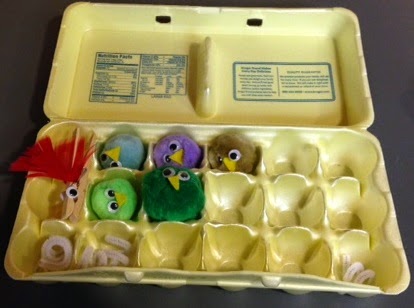
Feed the Baby Birds. This activity comes from Powerful Mothering and it's another simple activity great for developing fine motor skills and reinforcing science concepts. I made "baby birds" out of large pom poms (hot-glued on wiggle eyes and yellow felt beaks), "worms" out of white pipe cleaners (curl them around your finger), and "mommy birds" out of clothespins. Kids could use the clothespins to feed worms to the baby birds and move them around the "nest". I had a few friends who camped out at this station and didn't want to leave it behind!
Bird Beaks. This one is from To the Moon and Back, adapted with what I had on hand. Each tool (slotted spoon, tweezers, clothespin) represents a different kind of beak you might find in the bird world. Which type of beak works best for each food? The foods I used were small pom poms (replacing the mini marshmallows that Dusty used because I was afraid those would get eaten), dry black beans (leftover from last week's sound program), and more of our pipe cleaner "worms". I tried to talk to kids as much as I could at this station because while they loved dumping everything in the water and stirring, it's not a very self-explanatory station. This might be a better station with a smaller group or one-on-one.
We had our biggest crowd yet for this Preschool Lab (I counted 30 kids in the room) and I'm so happy to share a program I felt great about with such a great crowd! We only have one more week of summer Preschool Lab, and I'm definitely going to write up how the program went overall once we're done.
Wednesday, July 9, 2014
Science Explorer Table at the ALSC Blog
Friends, I'm over at the ALSC Blog talking about our Science Explorer Table that we've had out this summer. Click on through and give me some self-directed science activity ideas so we can keep this good thing going!
.JPG)
Monday, June 2, 2014
Preschool Lab: My Body
This summer, I'll be doing Preschool Lab every week since we're concentrating on science with our Fizz Boom Read Summer Reading Club. This week, we talked about the human body and some of the body parts inside us. I borrowed heavily from Amy Koester's Body Science program, which made planning super easy! Make sure you click through and see what she did.
.JPG)
.JPG)
.JPG)
.JPG)
Here's what I did!
Storytime:
Opening Song: My Hands Say Hello - this is our standard opener for all preschool storytimes. It's especially relevant here because we're talking about body parts!
Book: Parts by Tedd Arnold. I read this silly story about a boy who thinks he's coming apart because he notices hair in his comb, peeling skin, and something gray fall out of his nose. It's a funny intro to different body parts.
Felt: Body parts. I used the templates that Amy linked to to create a felt person with various body parts. As I put the parts up on the board, we talked about where they are in the body and what they do. The body parts I included were lungs (we all took a couple deep breaths), stomach, brain, and heart. I also included the bones to tie in to our next book.
Book: Dem Bones by Bob Barner. Before I read this book, I asked the kids to tell me where they could feel bones inside their bodies. You can feel bones in your forearm, your lower leg, your fingers, your toes, etc. I sang the book and as I turned each page, I asked children to find the body part it talks about.
Song: Head, Shoulders, Knees, and Toes. Besides just being one of my favorite storytime songs, this is a great song when you're talking about body parts. I like to do it slowly and then repeat it faster and faster. When we were done doing it SUPER FAST, I told the kids to feel their heartbeats!
Song: Head, Shoulders, Knees, and Toes. Besides just being one of my favorite storytime songs, this is a great song when you're talking about body parts. I like to do it slowly and then repeat it faster and faster. When we were done doing it SUPER FAST, I told the kids to feel their heartbeats!
Closing Song: Do You Know What Time It Is? - our standard closer, which signifies to the kids that storytime is over.
After our storytime, families were invited to explore the stations I had set out. I encouraged grown-ups to talk to their kids as they worked at each station, to reinforce our new vocabulary and concepts.
Stations:
Stomach:
I ran this station just like Amy did in her program. I put out plastic baggies (I didn't tape mine and they held up just fine) and various foods. Kids put some food in their baggies and then ground it up just like our stomachs grind up the food we eat. The kids really enjoyed smashing the stuff in their baggies! I provided sheets for them to draw what their food looked like before and after it was smashed, but many families skipped this step; they were so eager to get to the smashing!
Bones:
I found this idea on Coyne's Crazy Fun Preschool via Pinterest. I had volunteers cut out body shapes for me ahead of time and I provided glue, scissors, and q-tips for children to add the bones to their person.
Heart:
Again, this one came right from Amy's program. This station was the least-used and I think I had plenty to do without it. It was kind of loud in the room and I'm not sure that kids could really hear a heartbeat anyway. I think a few people visited this station, but families gravitated towards the stations where they created something.
Take-Home: Because one of our prizes for the Summer Reading Club is a science activity to take home and do, I didn't want to give out a craft every week with Preschool Lab like I have during the school year. I still put together some activity ideas for families to do at home and I included a book list. I also included some fun, free printables from 2 Teaching Mommies. They still had some things to do at home, but it was much less labor-intensive to include printables than to put together all the pieces for a craft.
Of course, I also put out a display of books for families to check out.
We had a lot of fun with our Preschool Lab and I'm excited to continue for the rest of the summer!
Tuesday, April 22, 2014
Preschool Lab: Growing Things
This is our last week of storytimes for the spring and I held Preschool Lab on Monday. This month, we explored how things grow and we talked about tadpoles and frogs, seeds and plants, and caterpillars and butterflies. Here's what we did:
One little, two little, three little flowers
Four little, five little, six little flowers
Seven little, eight little, nine little flowers
Ten flowers in the spring
Give them rain and lots of sunshine
Give them rain and lots of sunshine
Give them rain and lots of sunshine
So they'll grow up tall!


Opening Song: My Hands Say Hello - our standard opener, a signal to kids that we're ready to start, and a chance to move a little bit to get some wiggles out.
Book: A Tadpole Grows Up by Pam Zollman. This easy reader nonfiction book goes through all the stages in a frog's life, from eggs to tadpoles to frogs. I didn't read every word, but we went through each page and talked about how the frog was changing. We talked about amphibians and how they are different from fish. I like using books with photos, and we talked about what a tadpole looks like.
Book: Ten Seeds by Ruth Brown. This book counts down from ten as ten seeds are planted and creatures begin eating them or accidentally destroying them on each spread. I like this book because it clearly shows what is happening underground (roots growing) and then what the plant looks like above ground as it grows. This is a great book for pointing out the parts of a plant (roots, stem, leaves, bud, flower).
Song: Ten Little Flowers (Tune: Ten Little Indians). I learned about this song from Storytime Katie and I use it because it talks about what plants need to grow. We match actions to words and it gives the kids a much-needed chance to stand up and move a little bit.
Four little, five little, six little flowers
Seven little, eight little, nine little flowers
Ten flowers in the spring
Give them rain and lots of sunshine
Give them rain and lots of sunshine
Give them rain and lots of sunshine
So they'll grow up tall!
Felt Story: The Very Hungry Caterpillar by Eric Carle. I used my flannel board set purchased from Lakeshore Learning. This is a familiar story to many kids and it's great for talking about the life cycles of butterflies - from egg to caterpillar to chrysalis to butterfly! I wanted to use this felt set because I left it up as one of our stations, but you could also use the print book or pop-up book!
Stations:
After our storytime (about 20 minutes), I let everyone break up and visit whichever stations they wanted. While the kids stayed seated, I briefly explained what each station was and I let families know they could spend as long or as short as they wanted at each station and when they were done, they were free to leave. I'm going to be doing preschool science programs all summer and I need to insert a line about early literacy and talk, sing, read, write, play in my intro. I think it will encourage parents to get involved with what their kids are doing and talk more!
Plant a Seed: I purchased all the materials for this station for about $15. We had 11 kids and TONS left over. I purchased peat pots, the smallest bag of potting soil I could find, and marigold seeds. Kids scooped soil into their pot, placed a few seeds in the pot, and covered the seeds with soil. In the take-home packet, I gave them additional instructions: place the pot in a sunny spot and the flowers should sprout in about 2 weeks! I provided bags (left over from last year's Summer Reading Club) for them to carry them home - I could just imagine people getting dirt all over their cars!
Sticky Table: Parts of a Plant: The sticky table is an idea I found on Pinterest via Teach Preschool and one I'm sure we'll use again! Tape contact paper sticky side up on a table. Provide felt pieces and let the kids built their own flowers. This is a great activity for encouraging them to use new words like seed, root, stem, etc. I provided sunflower seeds, yarn for roots, and felt pieces. The sticky table will hold the pieces in place, but you can move them around, pick them up so another kid can do it, etc. I only put a piece of tape on each edge, but it is pretty darn sticky, so when we do this again I'll actually put tape all around the edges.
Tadpoles!!!! I'm lucky to have a friend who gets tadpoles every year in his defunct swimming pool. We went out last weekend before the program and caught some tadpoles for the kids to observe. I put out magnifying glasses so kids could get a closer look. After the program, we released the tadpoles back into the wild. No tadpoles were harmed in the making of this program!
Felt Board & Life Cycle Toys: I left out the pieces for The Very Hungry Caterpillar on the felt board and I put out the Life Cycle Sequencing Kit, purchased at Lakeshore Learning. Kids really enjoyed handling the plastic figures and we had some great conversations!
Take-Home:
For their take-home project, I sent home the pieces to make this butterfly life cycle with pasta, found on The Thoughtful Spot Day Care. I did not include real leaves and sticks since I was prepping in advance, but I drew leaf shapes on scraps of green construction paper and included strips of brown construction paper that represent leaves and sticks.
Monday, April 7, 2014
Preschool Lab: Weather
This month for Preschool Lab, we talked about weather. This was a great week for it since we have been having LOTS of different types of weather recently. Here's what we did:

Opening Song: My Hands Say Hello - our standard opener and a signal to my friends that it's time to start storytime.
Book: Hello Sun by Dayle Anne Dodds, illustrated by Sachiko Yoshikawa (Dial, 2005). This book has bouncy, rhyming text that explores what we wear for different types of weather. This was a great book to introduce many kinds of different weather to our friends.
Book: Rain by Manya Stojic (Crown Books for Young Readers, 1999). In this book, we use all our senses to explore a rainstorm on the African plains. Our STEM moment for the day came when I read about rhino squelching in the mud after the rain and a chorus of "Eeeew!"s rang out. I explained that many animals bathe in mud to keep cool and to keep their skin healthy. One of my friends called out "Like pigs!" Exactly! What a great connection!
We also used some sound effects with this book - slapping our knees to make thunder sounds and I used the rainstick when the rain finally started coming down.
Book with Scarves: Duckie's Rainbow by Frances Barry (Candlewick, 2004). We practiced our colors and listening/following directions by reading this book with scarves. For more details about this activity, check out my recent spring storytime.
Book: It Looked Like Spilt Milk by Charles G. Shaw (HarperCollins, 1947). Clouds can be many different shapes, as we notice in this book.
Closing Song: Do You Know What Time It Is?
Stations:

Wind. We can't SEE wind, but we can see what it DOES. I put together a tub with different materials and put out a box of straws. Children blew through the straws to see which objects moved and which did not. To incorporate writing, I put out basic charts so that families could record which objects could be moved with breath and which could not.
Umbrella Counting Game. I made my own template for the Rainy Day Counting game I found on Kiwi Crate. Children could color and cut out their umbrella cards and use the blue craft marbles to count out raindrops. I included some additional activity ideas for the umbrella cards in their take-home packets. If you don't have craft marbles laying around, you can just as easily use cotton balls for cloud counting.
Temperature. I put out our thermometers (from a Lake Shore science kit) and cups of water, some of which were room temperature and some of which had ice cubes in them. Families could explore how to use a thermometer and whether our water was hotter or colder.

Felt Board. I put out felt pieces from our story It Looked Like Spilt Milk and I left out our rain stick for exploration.
I also put out a weather book display and take-home craft packets with the supplies to make this weather tracker from Storytime Katie!
And now, let's hope that our weather is taking a turn for the better (finally)!
Opening Song: My Hands Say Hello - our standard opener and a signal to my friends that it's time to start storytime.
Book: Hello Sun by Dayle Anne Dodds, illustrated by Sachiko Yoshikawa (Dial, 2005). This book has bouncy, rhyming text that explores what we wear for different types of weather. This was a great book to introduce many kinds of different weather to our friends.
Book: Rain by Manya Stojic (Crown Books for Young Readers, 1999). In this book, we use all our senses to explore a rainstorm on the African plains. Our STEM moment for the day came when I read about rhino squelching in the mud after the rain and a chorus of "Eeeew!"s rang out. I explained that many animals bathe in mud to keep cool and to keep their skin healthy. One of my friends called out "Like pigs!" Exactly! What a great connection!
We also used some sound effects with this book - slapping our knees to make thunder sounds and I used the rainstick when the rain finally started coming down.
Book with Scarves: Duckie's Rainbow by Frances Barry (Candlewick, 2004). We practiced our colors and listening/following directions by reading this book with scarves. For more details about this activity, check out my recent spring storytime.
Book: It Looked Like Spilt Milk by Charles G. Shaw (HarperCollins, 1947). Clouds can be many different shapes, as we notice in this book.
Closing Song: Do You Know What Time It Is?
Stations:
Wind. We can't SEE wind, but we can see what it DOES. I put together a tub with different materials and put out a box of straws. Children blew through the straws to see which objects moved and which did not. To incorporate writing, I put out basic charts so that families could record which objects could be moved with breath and which could not.
Umbrella Counting Game. I made my own template for the Rainy Day Counting game I found on Kiwi Crate. Children could color and cut out their umbrella cards and use the blue craft marbles to count out raindrops. I included some additional activity ideas for the umbrella cards in their take-home packets. If you don't have craft marbles laying around, you can just as easily use cotton balls for cloud counting.
Temperature. I put out our thermometers (from a Lake Shore science kit) and cups of water, some of which were room temperature and some of which had ice cubes in them. Families could explore how to use a thermometer and whether our water was hotter or colder.
Felt Board. I put out felt pieces from our story It Looked Like Spilt Milk and I left out our rain stick for exploration.
I also put out a weather book display and take-home craft packets with the supplies to make this weather tracker from Storytime Katie!
And now, let's hope that our weather is taking a turn for the better (finally)!
Tuesday, February 25, 2014
Preschool Lab: Building
We're back from storytime break and I finally got to do another Preschool Lab! This week, we talked about building and construction, exploring the concept in a brief storytime (20 minutes) and then opening up for playtime with lots of different building materials.
Opening Song: My Hands Say Hello
Book: Tip Tip, Dig Dig by Emma Garcia. This is a great book for audience participation. I had the kids dig, roll, lift, and push along with me as we read the text.
.JPG)
Song: Dump Truck. I found this song on Katie Salo's Storytime Katie blog. The kids loved it!
(Tune: Bumpin' Up and Down in my Little Red Wagon)
Bumpety-bumpety goes the dump truck!
Bumpety-bumpety goes the dump truck!
Bumpety-bumpety goes the dump truck!
Duuump out the load!
We sang it through once and then I asked what we should put in our dump truck. The kids suggested wood, sand, and concrete as we sang the song again several times.
Book: Construction Zone by Cheryl Willis Hudson and Richard Sobol. I wanted to use a book with actual pictures and this is a great one. The text is a little long for my preschool audience, so I paraphrased or just described what was happening in the pictures. As much as I could, I tried to relate the building in the book to our library building, pointing out our two floors, the fixtures in our story room, etc. Both of the books we read today have lots of great vocabulary words!
Rhyme: Five Little Nails. I got this rhyme and prop idea from Melissa Depper at Mel's Desk, but we actually didn't use it today. I had it in my plan, but the kids were a little squirrelly after that longer book, so I decided to skip the rhyme and go right into our felt activity, which would give them a chance to get up from their seat.
Felt Board Activity: Color Machines. I passed out the machines and had each child bring their machine up to our "Construction Zone" as I called for it. (Our set of color machines includes one in each color that does not have a felt backing and has a label with the machine name on it, which makes it easier! This is a great activity for reinforcing some of the vocabulary words we'd heard in our books. Also, using activities where children approach the storyteller helps them get used to approaching adults outside their family (including, one day, their schoolteacher!).
Stations: Today we were all about building, which was lots of fun and pretty easy to put together (win-win). I had stations where the kids could build with Duplos, build with recycled materials, and play on the felt board with our color machines.


I encouraged everyone to take a craft packet home. I had a handout with several extension ideas and a book list. In their packet, I included a half-sheet of construction paper and a bunch of shapes cut out from our paper scraps. The instructions encouraged children to build a "shape town" out of the shapes.
.JPG) |
| Books on display and our take-home craft packets |
Opening Song: My Hands Say Hello
Book: Tip Tip, Dig Dig by Emma Garcia. This is a great book for audience participation. I had the kids dig, roll, lift, and push along with me as we read the text.
Song: Dump Truck. I found this song on Katie Salo's Storytime Katie blog. The kids loved it!
(Tune: Bumpin' Up and Down in my Little Red Wagon)
Bumpety-bumpety goes the dump truck!
Bumpety-bumpety goes the dump truck!
Bumpety-bumpety goes the dump truck!
Duuump out the load!
We sang it through once and then I asked what we should put in our dump truck. The kids suggested wood, sand, and concrete as we sang the song again several times.
Book: Construction Zone by Cheryl Willis Hudson and Richard Sobol. I wanted to use a book with actual pictures and this is a great one. The text is a little long for my preschool audience, so I paraphrased or just described what was happening in the pictures. As much as I could, I tried to relate the building in the book to our library building, pointing out our two floors, the fixtures in our story room, etc. Both of the books we read today have lots of great vocabulary words!
Rhyme: Five Little Nails. I got this rhyme and prop idea from Melissa Depper at Mel's Desk, but we actually didn't use it today. I had it in my plan, but the kids were a little squirrelly after that longer book, so I decided to skip the rhyme and go right into our felt activity, which would give them a chance to get up from their seat.
Felt Board Activity: Color Machines. I passed out the machines and had each child bring their machine up to our "Construction Zone" as I called for it. (Our set of color machines includes one in each color that does not have a felt backing and has a label with the machine name on it, which makes it easier! This is a great activity for reinforcing some of the vocabulary words we'd heard in our books. Also, using activities where children approach the storyteller helps them get used to approaching adults outside their family (including, one day, their schoolteacher!).
Stations: Today we were all about building, which was lots of fun and pretty easy to put together (win-win). I had stations where the kids could build with Duplos, build with recycled materials, and play on the felt board with our color machines.
The kids had a BLAST building with all our recycled materials. For about 2 weeks before the program, I collected any clean boxes and egg cartons that our library staff was willing to bring in for me. We had cereal boxes, cake mix, crackers, paper clips, etc. I had volunteers tape up the open ends to give the boxes a little more structural integrity.
This activity was cheap and pretty easy to put together. I especially wanted to try it to demonstrate to parents that you don't need to buy fancy toys to have fun. Probably everybody has some small cardboard boxes they can save up or solicit from friends who would otherwise be throwing them away. One of the parents commented that she had no idea how much fun small cardboard boxes could be and they will be trying this at home. Mission accomplished. :)
ETA (3/3/14): The science comes in here as kids experiment with building with different materials. What happened when the piece they had didn't fit where they thought it would? How could they use different shapes? What happened when their buildings became top-heavy? How could they balance different "blocks" to create taller towers? How could they provide more support to create bridges and other structures? I saw kids experimenting and answering these questions for themselves as they played.
As the kids built, I talked to them about what they were building, what pieces they needed, who lived in their castles, etc.
We're planning to do a weekly storytime and building night this summer and we'll definitely be saving our recyclables again for this activity.
Subscribe to:
Posts (Atom)